AI construction contract review software that applies your approved positions in Word
BlackBoiler turns your standards, previous redlines, and examples into first pass tracked changes across prime contracts, subcontracts, and professional services agreements, including contracts built on AIA, ConsensusDocs, and EJCDC forms.
Who it is built for
Built for construction review where positions have to hold across projects.
Construction teams review recurring agreement types across different owners, contractors, consultants, and project requirements. Reviewers span project, commercial, procurement, contracts, and legal teams, and the positions they apply already exist in prior negotiations, approved language, review guidance, or earlier redlines.
Legal and contracts reviewers who own the positions
You hold the standards the team negotiates against. BlackBoiler takes your prior redlines, approved language, and playbook and applies them to each new agreement, so the first pass already reflects the positions you would apply.
Commercial and procurement leads watching the risk terms
You care where insurance, payment and retainage, bonds, scope, and flow down obligations land. BlackBoiler carries those requirements into the markup, so the terms that move risk are handled before the agreement goes forward.
Project teams handling many agreements at once
Owner agreements, subcontracts, and professional services agreements each arrive with their own terms. BlackBoiler gives every one a common starting point from your approved positions, while each contract is still reviewed against its own language and context.
The manual gap
Manual construction contract review leaves the reviewer to reconcile the inputs
Construction agreements rarely arrive with every review decision in one place. Relevant positions sit in earlier negotiations, previous redlines, project requirements, insurance comments, scope documents, or existing guidance.
Your standards are already set. Yet on every agreement, a skilled reviewer still has to find them, compare them, decide what applies, and rebuild the markup by hand.
Different review inputs have to become one workable redline
Legal positions, commercial concerns, insurance requirements, and project-specific terms come from different parts of the business. Before the agreement moves forward, the reviewer has to weigh those inputs and reflect the right changes in the contract.
Previous project decisions have to be found and reassessed
An earlier agreement with the same counterparty may contain language that has already been negotiated and accepted. A similar project may show a fallback that worked before. That history is useful, but someone still has to find it, compare it with the new wording, and decide whether it applies again.
More projects repeat the same work
Each new owner agreement, subcontract, or professional services agreement brings another set of terms, exceptions, and review decisions. As project volume grows, the same comparison and reconciliation repeat across more contracts and more reviewers.
Carry approved positions across the contracts that shape each project
Construction projects create different contractual relationships, and each agreement allocates risk differently. Owner agreements, subcontracts, and professional services agreements may use AIA, ConsensusDocs, EJCDC, or other standard forms, but the starting document must still be reviewed against your organization's positions.
Those positions may cover indemnity, duty to defend, insurance, payment and retainage, pay-if-paid terms, liquidated damages, delay, change orders, warranties, liens, flow-down obligations, bonds, standard of care, termination, and other recurring construction risks.
Owner agreements set the risk framework for the project
Owner agreements determine how responsibility is shared between the owner and the contractor. Your approved positions determine how the indemnity, insurance, payment, and delay terms in that framework are reviewed and amended before the agreement moves forward.
Subcontracts have to carry upstream commitments down
A subcontract must reflect obligations already established above it in the project structure. The review checks that flow-down requirements, pay-if-paid language, bonds, and scheduling terms match the commitments your organization has made upstream.
Professional services agreements turn on the standard of care
Architects, engineers, and other consultants carry obligations that differ from those of contractors. Here the review centers on the standard of care, ownership of work product, liability, and dispute provisions, applied against the positions your organization uses for these agreements.
How BlackBoiler works for construction contract review
Start with one agreement type and the material that already carries your organization's positions on it. BlackBoiler builds the playbook from that history, applies the relevant rules to new contracts in Word, and checks the result before it reaches the reviewer.
Upload the construction material you already rely on
Use previous redlines, an existing playbook or policy document, written guidance, and examples from the same agreement type. BlackBoiler identifies the review rules reflected in those materials. Your team decides which belong in the playbook and where further guidance is needed.
Build the playbook around the agreement type
Owner agreements, subcontracts, and professional services agreements raise different issues. The playbook captures the positions relevant to that contract type, including the fallbacks, requirements, and language your organization uses during review.
Run the incoming agreement in Microsoft Word
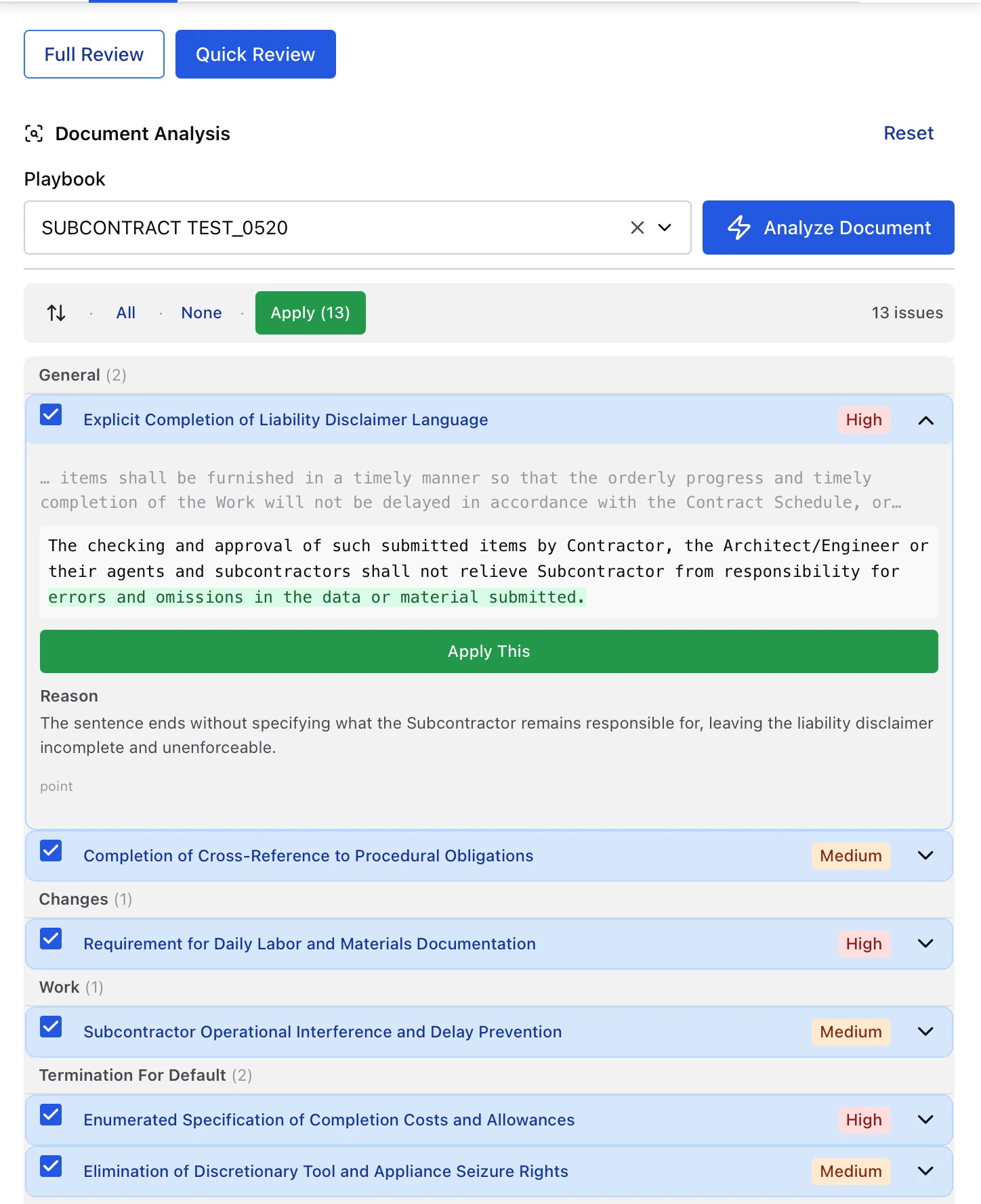
Select the relevant playbook and run the new contract in Word. BlackBoiler finds the language covered by your rules and proposes revisions and comments directly in the document. The markup responds to the wording in that agreement rather than copying a change from an earlier contract.
BlackBoiler checks the edit before the reviewer sees it
Each edit is checked against the outcome your playbook defines and the evidence of how your organization has handled that position before. A judge validator assesses whether the edit aligns with that outcome, and statistical similarity checks add further evidence. The checks support the quality of the first pass — they do not replace the reviewer's judgment.
Work through the provisions that still need judgment
The reviewer assesses the first pass in Word, handles exceptions, and decides what to accept, change, reject, or escalate. Where a clause needs closer attention, Veris helps work through the language without moving the review away from the contract.
What legal teams say about using BlackBoiler AI for contract review
A unique and powerful feature
One of my favorite aspects of BlackBoiler is its ability to automate contract review and save time and resources, especially for in-house legal teams who may be overwhelmed with the volume of contracts they review on a regular basis. The ability to build a legal playbook directly in the tool and have it review and mark up contracts according to the playbook is a unique and powerful feature. It allows businesses to tailor the review process to their specific needs, and it can be quickly and easily implemented into a workflow.Alex S.
User friendly and easy to navigate
The interface is user friendly and easy to navigate. The tool uses natural language processing to analyze the text and highlight clauses that may need attention. It also lets users create and manage their own markup rules and templates, tailoring the software to their specific needs, and customer support is excellent.Chandra S.
Faster review you can rely on
BlackBoiler Automated Contract Markup helps speed up the contract review process and make it better. A company or person can save time analyzing large contracts, because the efficiency of the tool is one we can rely on.Verified User
Useful templates and exhaustive coverage
Useful templates and easy options to change terms, with exhaustive coverage. It saves time in drafting..Huzaifa F.
See your construction contract standards applied to a real agreement
Bring a recurring agreement and the material your team already reviews against: prior redlines, approved language, or existing playbook guidance. BlackBoiler returns a first pass in Microsoft Word you can hold against the edits your team would have made by hand.
Questions about AI construction contract review
How should we test BlackBoiler before relying on it for contract review?
Test BlackBoiler against representative agreements, known difficult clauses, previous redlines, and positions your team already understands. Compare the proposed edits with the outcomes you expect from your playbook and prior decisions. BlackBoiler also checks proposed changes against the playbook outcome and company evidence, while the responsible reviewer evaluates the final markup.
How does BlackBoiler handle contract language that does not match our usual wording or examples?
BlackBoiler applies the relevant positions in your playbook to the language in the agreement. Playbooks draw from your existing contracts, approved positions, and BlackBoiler's prebuilt rules library. BlackBoiler flags relevant contract language and proposes edits as tracked changes in Microsoft Word, leaving unusual language and exceptions visible for the responsible reviewer to assess.
How does BlackBoiler handle complex construction agreements?
BlackBoiler applies the positions defined in the relevant playbook across complex agreements and returns proposed changes for review in Microsoft Word. Output quality depends on playbook coverage, the language and context of the agreement, and the evidence available to assess the proposed edit. The responsible reviewer remains accountable for exceptions and final decisions.
Does BlackBoiler replace our CLM?
BlackBoiler focuses on the pre-execution contract review and redlining process. It applies your approved positions, prepares the first pass, and returns the markup in Microsoft Word for review. Your existing CLM can continue to manage the broader contract lifecycle before and after that review step.
How does BlackBoiler check the accuracy of proposed redlines?
BlackBoiler checks proposed edits against the outcome defined in the playbook and organization-specific evidence, including approved language, previous redlines, and examples. Statistical similarity checks provide additional evidence for the assessment. The checking process does not guarantee correctness, so the responsible reviewer still evaluates the tracked changes and resolves exceptions.
What role does the reviewer have after BlackBoiler prepares the first pass?
BlackBoiler prepares the first pass by applying approved positions and returning proposed edits as tracked changes and comments in Microsoft Word. The responsible reviewer evaluates the markup, resolves exceptions, revises language as needed, and decides what to accept, reject, escalate, or negotiate within the organization's existing review and approval process.
How does BlackBoiler handle security review?
BlackBoiler provides security information for review as part of the evaluation and procurement process. The SOC 2 report is available under NDA, and your security team reviews the current product and security documentation before approval. Contract data and security requirements remain subject to your organization's own security and procurement review.
Does BlackBoiler work with our existing construction contract playbook?
BlackBoiler uses your approved language, previous redlines, examples, and review guidance to build executable playbook logic around the positions your organization already uses. The goal is not to replace your standards. It is to apply them more consistently across recurring construction agreements and return a usable first pass for review.
How does BlackBoiler handle contract data?
Your contracts, playbooks, redlines, and negotiation positions are not used to train models or improve BlackBoiler for other clients. BlackBoiler's SOC 2 attestation provides independent assurance that controls are in place for the secure and responsible handling of customer data. The SOC 2 report is available under NDA.
Your contract data stays yours
Use BlackBoiler without giving up control of your contract data
BlackBoiler applies your organization's standards inside your own account. Your contracts, playbooks, redlines, and negotiation positions are not used to train models or to improve BlackBoiler for other companies. Request access to our SOC 2 report, available under NDA, for independent assurance on the controls that protect and handle your data.
- Your contracts stay private
- Your positions remain proprietary
- Human review stays in control
About BlackBoiler
Contract review from a company that has done this since 2019
BlackBoiler has focused on automated contract redlining since 2019, before the current wave of legal AI. The technology is patented and purpose-built for one job: carrying the positions a legal team has already developed into first pass tracked changes in Microsoft Word, with the output checked before it reaches the lawyer and again during review.
Built on your standards, not a general model
Your playbook, previous redlines, approved language, and examples inform the positions BlackBoiler applies. The review starts from contract knowledge your team has already built, rather than a general-purpose model working from a prompt. The lawyer decides what to accept, change, reject, or negotiate.
Put your approved positions to work on the next recurring agreement
Test BlackBoiler on contract language your team already knows and judge the first pass against the markup you would have created by hand.